
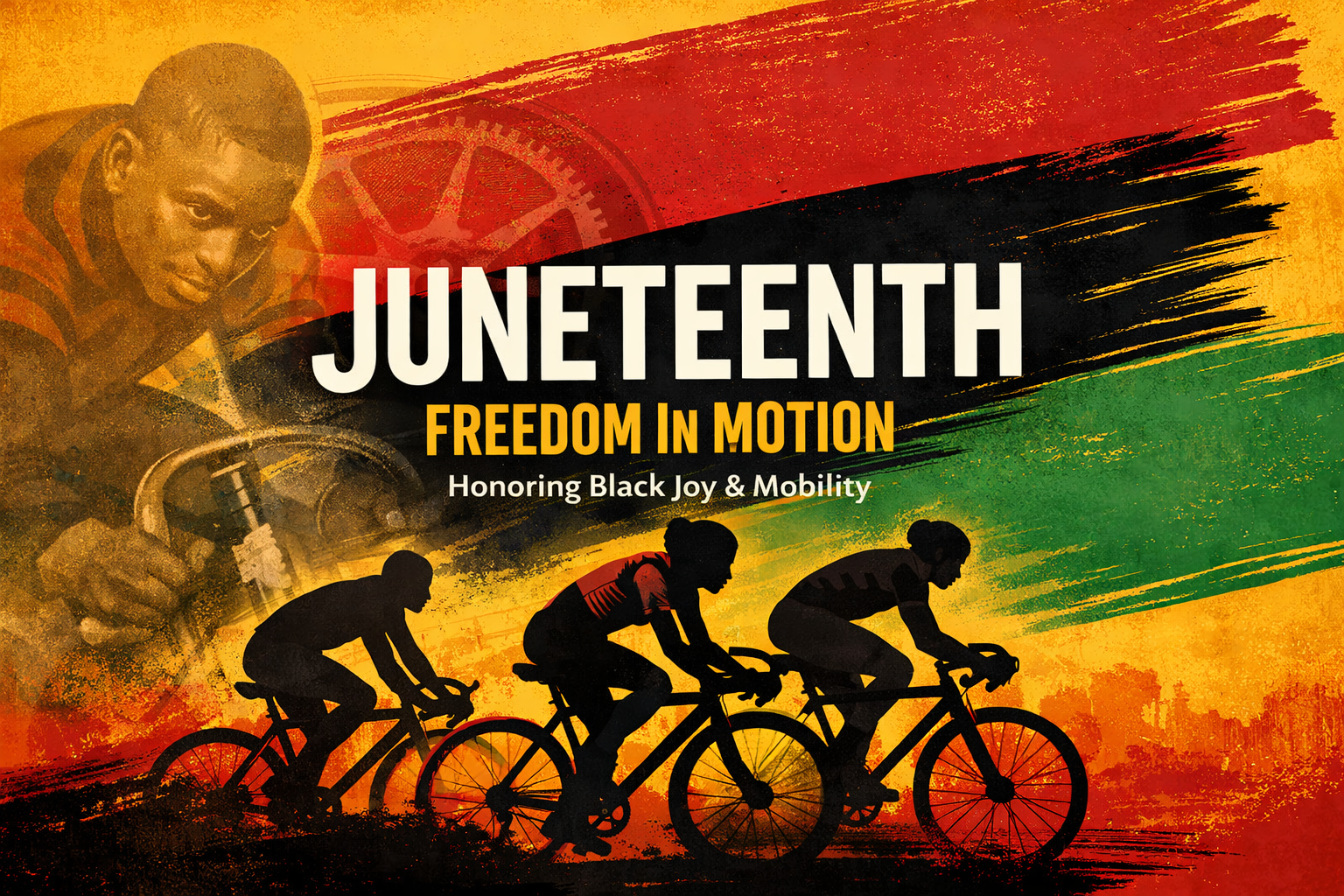
Juneteenth is a celebration commemorating the end of slavery in the United States. On June 19, 1865, in Galveston, Texas, more than 250,000 enslaved Black Americans learned they were free — two and a half years after freedom had already been written into law. Today, Juneteenth honors Black freedom, joy, expression, and the continued fight for equality. Cities across the U.S. are hosting community rides to celebrate Black joy and togetherness, including Atlanta’s Red, Black, and Green Ride, Oakland’s Freedom Ride, and rollouts across Los Angeles.
These rides sit inside a longer lineage of Black mobility. Marshall “Major” Taylor isn’t the focus here, but his legacy is always present — a Black world champion in 1899 who outran Jim Crow hostility and proved that movement itself could be resistance. His story reminds us that Black cyclists have always existed, always excelled, even when the road was designed to shut us out.
Before HCBL, I led a Black Girls Do Bike chapter in the Bay Area. Those rides were more than miles — they were community architecture. A place where Black women could claim space, learn together, and move without apology. That same spirit shows up in DC’s T.A.L.L. rides, where Black cyclists gather to move through the city on their own terms.
The numbers still tell a parallel story: Black cyclists remain underrepresented in competitive cycling and on Olympic rosters, even as our presence in community cycling grows. The gap between who rides and who gets recognized mirrors the gap between when freedom was declared and when it was actually delivered.
For me, the bicycle is a symbol of liberation — a counter‑narrative to systems that use infrastructure, policing, and car dependency to restrict movement. Riding is how I reclaim space in a city built on inequity. It’s how I practice freedom in motion. It’s how I stay connected to a tradition where mobility has always been a form of self‑determination.
At Happy Chaos Bike Lab, we honour Juneteenth by moving — together, intentionally, joyfully. Our work is rooted in the belief that mobility is a right, not a privilege. That youth deserve safe streets, working bikes, and the confidence to navigate their world. That liberation is not abstract; it’s practiced in the everyday act of choosing your own direction.
Juneteenth reminds us that freedom delayed is not freedom denied. And every time we ride, we carry that truth forward.
AUTHOR